


Jul 20, 2026
UAE E-Invoicing & Payment Links Guide (2026-2027)
Share this article
- The Complete Guide to E-Invoicing and Payment Links:2026-2027 UAE
- TL;DR
- What UAE E-Invoicing Actually Means
- Why the FTA Is Doing This Now
- The Five-Corner Model, Explained Simply
- The UAE E-Invoicing Timeline: Who Needs to Move, and When
- Mandatory Invoice Fields, In Plain Language
- What Your Invoices Must Contain Under PINT-AE
- What Happens If You're Not Ready
- Choosing an Accredited Service Provider (ASP)
- Payment Links: The Half of This Story Most Guides Skip
- Where E-Invoicing and Payment Links Actually Overlap
- What UAE SMEs Should Actually Do Before Their Deadline
- Which Industries and Businesses This Applies To
- FAQ About E-Invoicing UAE and Payment Links
- Final Thoughts
The Complete Guide to E-Invoicing and Payment Links:2026-2027 UAE
TL;DR
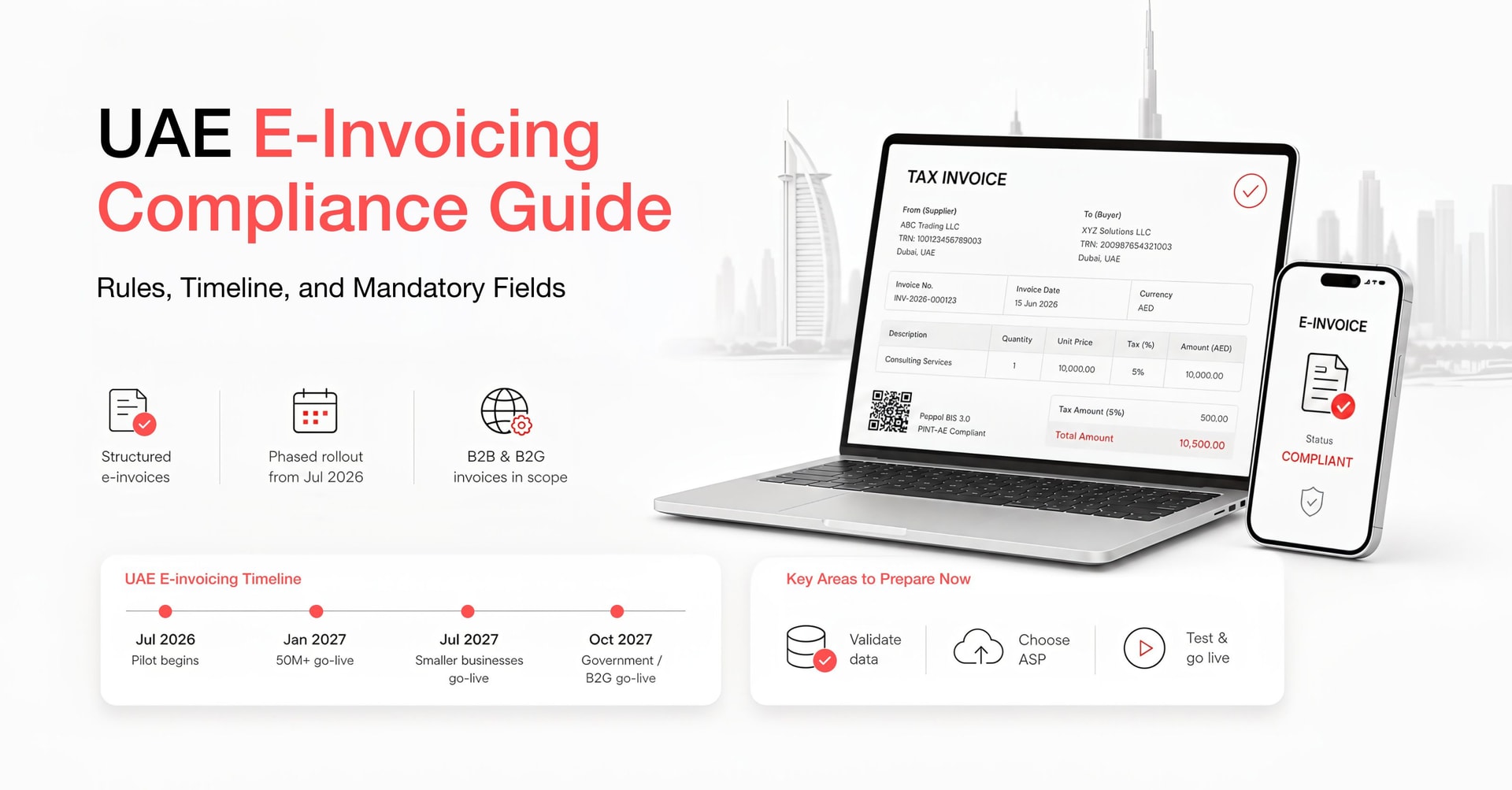
- The UAE's e-invoicing mandate goes live in phases: voluntary from 1 July 2026, mandatory for large businesses (above AED 50 million revenue) from 1 January 2027, and for everyone else from 1 July 2027.
- A compliant e-invoice is a structured PINT-AE file sent through an Accredited Service Provider (ASP), not a PDF, scanned copy, or Word document. Those formats stop counting once your phase kicks in.
- E-invoicing solves compliance; it does not solve collections. A payment link is a separate, complementary tool that gets you paid faster once the invoice is out.
- Most UAE guidance treats these as two projects. Businesses that treat them as one, choosing a platform that issues compliant invoices and collects payment on the same link, avoid double the setup work later.
Ask ten UAE business owners about e-invoicing UAE rules and you'll get ten different half-answers. Ask them about payment links and you'll get a shrug, or a WhatsApp message with a Tap or Mamo link pasted into it. That gap, between what's about to become a legal requirement and what already quietly runs collections for thousands of SMEs, is where this guide sits.
Both topics matter to the same finance team, often in the same week. So instead of treating them as unrelated (most articles do), this one walks through the actual FTA mandate, what a payment link is and costs, and where the two overlap in a way that changes how you should be shopping for tools right now.
What UAE E-Invoicing Actually Means
E-invoicing is the legal requirement to issue, transmit, and receive tax invoices as structured data through an accredited platform, not as a PDF, image, or paper document, so the Federal Tax Authority can validate and receive the underlying VAT data automatically.
The framework comes from Ministerial Decision No. 243 of 2025 (the e-invoicing system itself) and Ministerial Decision No. 244 of 2025 (its phased rollout). The FTA is the authority enforcing it, and the format businesses must use is PINT-AE, the UAE's localised version of the international Peppol invoice standard, built on UBL 2.1 structured XML.
Here's the part that trips people up: a beautifully formatted PDF invoice, or an invoice attached to an email as a Word document, will not count as a legal tax invoice for in-scope transactions once your mandate date arrives. The system only recognises machine-readable PINT-AE files transmitted through an Accredited Service Provider (ASP). Everything else, however professional it looks, is functionally invisible to the FTA.
Why the FTA Is Doing This Now
The UAE introduced VAT in 2018 and corporate tax in 2023. E-invoicing is the next layer: a way for the FTA to receive transaction-level VAT data in close to real time instead of relying on periodic returns and after-the-fact audits.
There's a regional pattern behind it too. Countries with VAT or GST systems across the world, Saudi Arabia included, have moved toward mandatory e-invoicing over the past few years, and the UAE is aligning itself with that direction rather than lagging behind it. For a country that positions itself as a digital-first trading hub, manual PDF invoicing was always going to be a temporary state.
The practical upside for businesses that get ahead of it: fewer manual reconciliation errors, a cleaner audit trail, and invoice data that flows straight into accounting software instead of being retyped.
The Five-Corner Model, Explained Simply
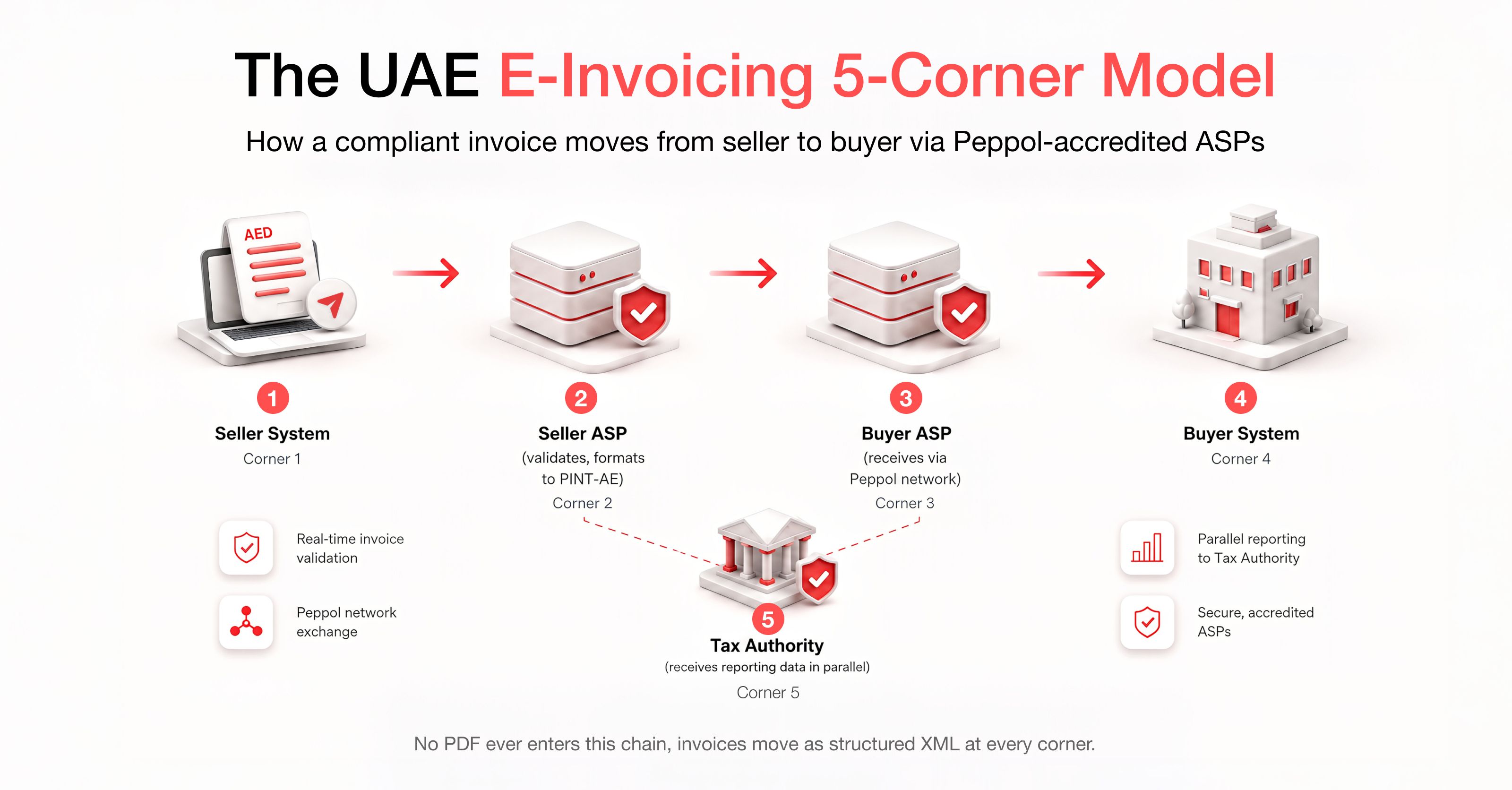
If you've read anything about European e-invoicing, you may have seen the "four-corner model": supplier, supplier's service provider, buyer's service provider, buyer. The UAE adds a fifth corner: the FTA itself.
Here's the flow in practice. You issue an invoice through your chosen ASP. Your ASP validates it against the UAE schema and transmits it to your buyer's ASP, while simultaneously reporting the tax data to the FTA. Your buyer's ASP validates the file and delivers it into your buyer's system, and reports the transaction back to the FTA from their side too.
Two things worth knowing. First, this is decentralised. You are not logging into a single government portal to upload every invoice by hand; your ASP handles the exchange. Second, the FTA is not pre-approving each invoice before it reaches your buyer, so day-to-day commercial flow shouldn't slow down once you're set up. What does not go away is your responsibility: you remain accountable for the accuracy and timeliness of what your ASP submits on your behalf.
The UAE E-Invoicing Timeline: Who Needs to Move, and When
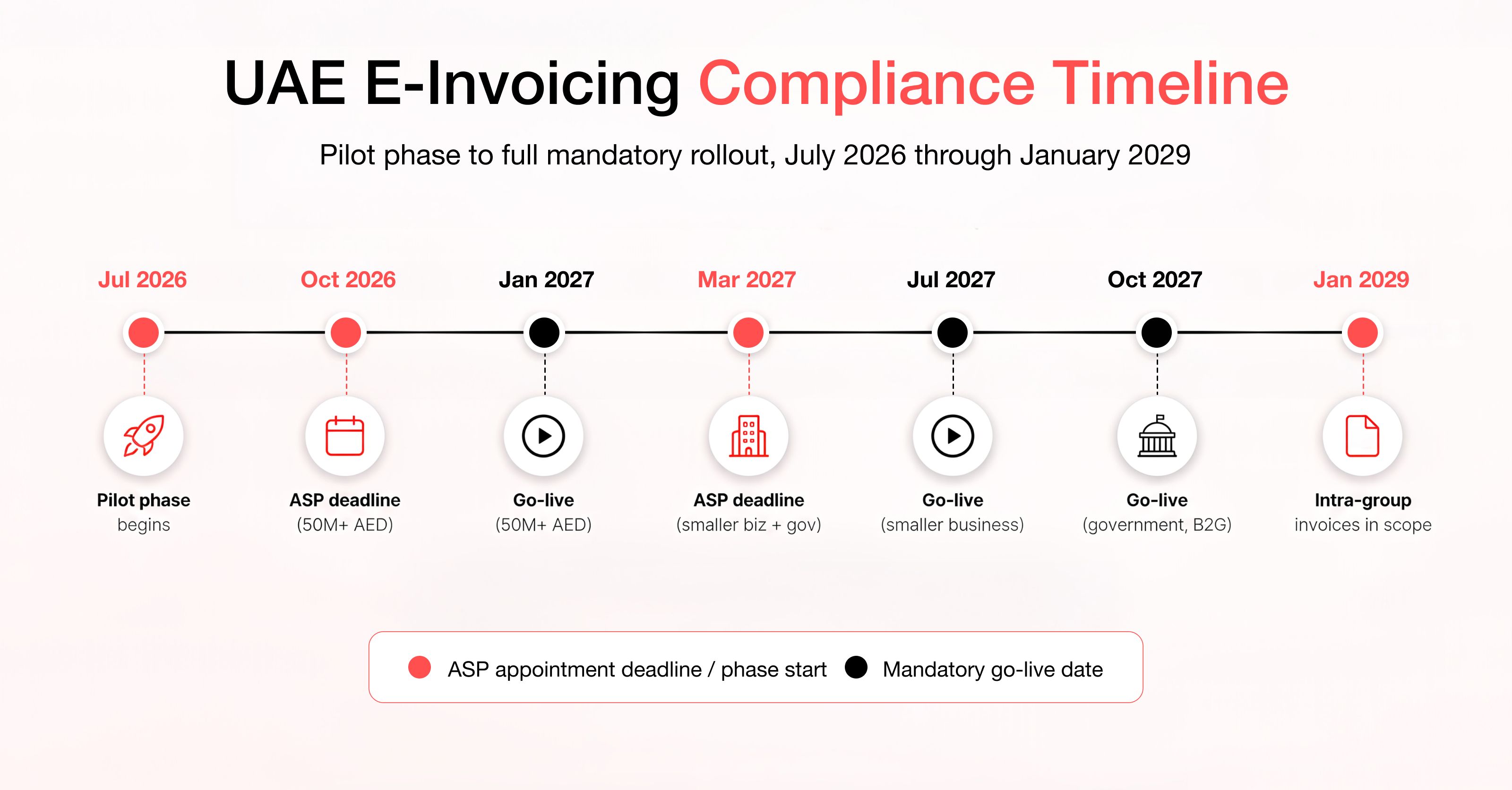
Here is every phase of the roll-out in one place, including the ASP appointment deadlines that come well before each go-live date:
Date | Milestone | Who it affects |
1 July 2026 | Pilot and voluntary adoption phase begins | Taxpayer Working Group members and early voluntary adopters |
30 October 2026 (extended from 31 July 2026) | Deadline to appoint an Accredited Service Provider | Businesses with annual revenue AED 50 million or more |
1 January 2027 | Mandatory go-live, fixed and unchanged | Businesses with annual revenue AED 50 million or more |
31 March 2027 | Deadline to appoint an ASP | Smaller businesses (under AED 50 million) and government entities |
1 July 2027 | Mandatory go-live | Businesses with annual revenue under AED 50 million |
1 October 2027 | Mandatory go-live | Government entities (B2G transactions) |
January 2029 | Intra-group transactions brought into scope | Group companies invoicing each other |
The ASP deadline extension is worth pausing on. On 10 May 2026, MoF amended Ministerial Decision No. 244 of 2025, moving the large-business ASP appointment deadline from 31 July to 30 October 2026, citing feedback from businesses about needing broader provider options and more competitive pricing.
At the same time, MoF was explicit that the 1 January 2027 go-live date has not moved. Read the extension as breathing room to choose the right provider, not as the deadline softening. Businesses that treat it as a delay tend to end up rushing an ASP contract in December.
As of that same announcement, 32 service providers had been approved, with more in the final stages of accreditation, so the ASP market is filling out but hasn't fully matured yet. That's a real factor in how you shortlist providers, covered below.
Mandatory Invoice Fields, In Plain Language
Every compliant invoice must carry a fixed set of data points across six categories, and missing even one causes the invoice to fail validation before it ever reaches your customer.
MoF's technical guidance, first published in February 2026 and refined in a June 2026 update, breaks the requirement into 51 fields across six groups.
Field category | Field count | Typical examples |
Invoice details | 9 | Invoice number, issue date, currency |
Seller details | 11 | Legal name, Tax Registration Number, structured address |
Buyer details | 9 | Legal name, TRN, structured address |
Document totals | 5 | Subtotal, total VAT, grand total |
Tax breakdown | 4 | VAT rate, taxable amount, tax amount, tax category |
Line items | 13 per line | Description, quantity, unit price, gross price, VAT per item |
A few practical points that trip businesses up:
• TRNs and structured addresses aren't optional extras. If your master data has free-text addresses or missing TRNs for some customers, that's a data cleanup project, not a technical one.
• VAT must reconcile in AED, even when you invoice in another currency. Foreign-currency invoicing without an AED conversion layer will fail validation.
• Line-item detail is granular. Lump-sum invoicing (one line, "services rendered") won't pass. Every line needs its own quantity, price, and tax treatment.
• The June 2026 update (version 1.1) kept the core structure the same but added clarity on record-keeping duties, the ASP's role in the chain, and how to treat advance payments and retention amounts, both common in UAE construction and services contracts.
What Your Invoices Must Contain Under PINT-AE
Whichever ASP you choose, your invoice template needs these fields validated and present, or the file gets rejected before it ever reaches your buyer:
- The words "Tax Invoice" clearly shown
- Supplier legal name, full address, and Tax Registration Number (TRN)
- Customer legal name and address, plus customer TRN if they're VAT registered
- A unique, sequential, non-duplicated invoice number
- Invoice date, and supply date if it differs from the invoice date
- A clear description of the goods or services, with quantity or service period
- Unit price before VAT, net amount before VAT
- VAT rate applied (5%, 0%, or exempt) and the VAT amount charged
- Gross amount including VAT
- Currency used; if it isn't AED, the VAT amount must still be shown in AED
Miss a field and the ASP's validation layer catches it before transmission, which is arguably the point: it forces the same rigor a good accountant already applies, just automatically.
What Happens If You're Not Ready
Non-compliance isn't a warning-letter situation. Under Cabinet Decision No. 106 of 2025, failing to implement the system or appoint an ASP by your deadline can trigger a penalty of AED 5,000 per month (or part of a month) of delay. Failing to issue and transmit invoices or credit notes correctly within the required timelines adds AED 100 per document, capped at AED 5,000 per calendar month. Two narrower penalties apply too: AED 1,000 per day of delay for failing to notify the FTA of a system malfunction, and AED 1,000 per day of delay for failing to notify your ASP of any change to your registered data.
Businesses using the system voluntarily are exempt from all of these until they become mandatorily subject to it.
Beyond the fines, there's a quieter cost: VAT reporting inaccuracies and audit complications for a business that simply wasn't watching the calendar.
Choosing an Accredited Service Provider (ASP)
The Ministry of Finance maintains the official list of pre-approved e-invoicing providers under Article 15 of Ministerial Decision No. 64 of 2025, published through the EmaraTax portal. The list has grown quickly: it stood at roughly 33 providers in mid-2026 and had reached 41 providers by June 2026, with new names still being added as recently as July 2026.
Pre-approval is also not the same as final accreditation, which is granted separately once a provider completes accreditation testing, so treat the live portal listing as the source of truth rather than any third-party summary, including this one.
A few practical filters when you're comparing ASPs:
Confirm PINT-AE and UBL 2.1 support explicitly, not just "e-invoicing compliant" marketing language.
Check whether the provider already integrates with your accounting or ERP system, since a standalone ASP that doesn't talk to your books just creates a second manual step.
If you operate across multiple entities or emirates, ask whether one provider can serve the whole group or whether you'll be coordinating several.
And because you remain accountable for what your ASP submits on your behalf, ask about their validation error rate and how disputes get resolved, not just their onboarding speed.
Payment Links: The Half of This Story Most Guides Skip
A payment link is a shareable URL that sends a customer to a secure, hosted page where they can pay by card, Apple Pay, Google Pay, or bank transfer. You generate it in seconds, send it over email or WhatsApp, and the funds settle into your account automatically, typically within 48 to 72 hours in the UAE market. No developer, no checkout page, no payment terminal.
That convenience shows up in the pricing too. Providers active in the UAE charge roughly 2.5% to 3.25% of the transaction plus a small fixed fee (commonly around AED 1), with some offering a lower rate if you pay a monthly subscription instead of staying purely pay-as-you-go. By 2026, 3D Secure authentication is the baseline expectation for any link-based transaction, not an optional add-on.
Here's the part worth sitting with: a payment link has nothing to do with e-invoicing compliance. It's a collections tool. You could issue a perfectly PINT-AE-compliant invoice through your ASP and still have no fast way to get paid for it, or you could have a slick payment link and an invoice that the FTA doesn't recognise as valid. They solve two different problems, and most of the content written about either one ignores the other entirely.
Where E-Invoicing and Payment Links Actually Overlap
This is the gap nobody else is writing about clearly: for a B2B invoice inside the mandate's scope, the compliant PINT-AE file and the thing your customer actually clicks to pay are not automatically the same object. Depending on your setup, you may need your ASP to handle the compliance side and a separate provider to handle the collection side, with someone on your team reconciling both against the same invoice number.
That's manageable at ten invoices a month. At two hundred, it's a spreadsheet nightmare waiting to happen, and it's exactly the kind of gap that shows up during an audit as "why doesn't this payment match a recognised invoice."
The businesses that handle this most cleanly are the ones using a single platform where invoicing and payment links live together, so one invoice produces both the compliant record and the payable link, with the same reference number tying them together automatically.
Peko's Invoicing & Payment Links product on its all-in-one UAE business platform works this way: create an invoice once, and it doubles as a shareable payment link with automated reminders and tracking, so collections and record-keeping stay attached to each other instead of drifting apart. One Peko customer, Crystal Quality, put it plainly: their invoicing and payment links "streamlined our billing process," with automated reminders and tracking cutting down manual follow-ups.
That's not a reason to skip evaluating ASP compliance carefully, you still need a provider that genuinely supports PINT-AE. It's a reason to ask, before you sign anything, whether your invoicing tool and your collections tool are the same conversation or two separate ones.
What UAE SMEs Should Actually Do Before Their Deadline
Start by identifying your phase. If your annual revenue clears AED 50 million, you're in Phase 1 and your ASP needs to be appointed by 30 October 2026 with go-live by 1 January 2027. Below that threshold, you have until 31 March 2027 to appoint a provider and until 1 July 2027 to go live, which sounds distant until you remember integration and testing eat months, not weeks.
Run a gap analysis on your current invoicing setup next. If you're still emailing PDFs or generating invoices from a spreadsheet template, that entire workflow needs replacing, not patching. Shortlist ASPs against the EmaraTax pre-approved list, check accounting-software integration, and confirm PINT-AE support in writing rather than in a sales deck.
Separately, and in parallel, look at how you currently collect payment once an invoice goes out. If that's a manual bank transfer chase or a payment link pasted in from a different tool than the one that generated the invoice, that's the moment to ask whether consolidating both into one platform saves your finance team the reconciliation headache described above.
For the wider cash-flow picture beyond e-invoicing alone, see Peko's business finance tips for UAE and India SMEs, which covers VAT thresholds, Small Business Relief deadlines, and forecasting alongside compliance topics like this one.
Which Industries and Businesses This Applies To
E-invoicing and payment links aren't equally urgent for every business, but the overlap is wider than most owners assume.
Trading, import-export, and wholesale companies are squarely in scope from day one; B2B invoicing is their core transaction type, and many already issue high volumes that make manual PDF workflows painful even before compliance forces the switch. Professional services firms, consultancies, and agencies invoicing corporate clients need both halves of this guide: compliant invoices for their B2B clients and fast payment links to avoid 60-day payment cycles eating their cash flow.
Construction and contracting businesses, with staged and milestone invoicing, benefit especially from a single reference number tying compliance and collection together across a long project.
Retail and e-commerce SMEs selling to other businesses (B2B wholesale alongside a B2C storefront) need to watch the B2B side closely, since that portion of their invoicing falls under the mandate even while consumer sales don't yet.
Freelancers and solo consultants under the VAT threshold have more breathing room on the compliance deadline but are often the ones who benefit most, right now, from a payment link simply because they don't have finance teams chasing bank transfers for them. Free zone companies, especially those planning Phase 2 or Phase 3 timelines, should treat 2026 as the year to pilot voluntarily rather than wait for a mandatory deadline to force a rushed vendor choice.
FAQ About E-Invoicing UAE and Payment Links
Is e-invoicing mandatory for all UAE businesses in 2026?
Not yet for most. Voluntary adoption and a pilot programme begin 1 July 2026, but mandatory implementation only starts 1 January 2027 for large businesses above AED 50 million in annual revenue. Smaller VAT-registered businesses have until 1 July 2027, and government entities until 1 October 2027.
What is PINT-AE and why does UAE e-invoicing require it?
PINT-AE is the UAE's localised adaptation of the international Peppol invoice standard, built on structured UBL 2.1 XML. The FTA requires it because structured data can be validated and exchanged automatically between systems, something a PDF or scanned invoice can't do.
Can I keep sending PDF invoices after the UAE e-invoicing mandate starts?
No, not for in-scope B2B and B2G transactions once your phase's mandatory date arrives. PDFs, scanned copies, images, and Word documents will not be recognised as valid tax invoices; only PINT-AE files transmitted through an Accredited Service Provider count.
How much do payment links cost for UAE businesses?
Most UAE providers charge a percentage of the transaction plus a small fixed fee, generally landing between roughly 2.5% and 3.25% per transaction plus about AED 1, with lower percentage rates sometimes available through a monthly subscription plan instead of pure pay-as-you-go.
Do payment links count as compliant e-invoices under the FTA mandate?
No. A payment link is a collections tool that gets a customer to a hosted page to pay; it has no bearing on whether your underlying invoice meets PINT-AE compliance. The two need to be handled together, ideally through one platform, but they are not interchangeable.
How do I choose an FTA-accredited service provider (ASP) in the UAE?
Check the Ministry of Finance's pre-approved provider list on the EmaraTax portal, confirm explicit PINT-AE and UBL 2.1 support, verify accounting or ERP integration, and ask how validation errors and disputes are handled before committing, since you remain accountable for what your ASP transmits on your behalf.
Final Thoughts
The e-invoicing mandate is a compliance deadline with real penalties attached, and it deserves the gap analysis and ASP shortlisting most advisors are already recommending. But treating it as the only project on your desk misses half the picture. Getting paid, quickly and without manual chasing, was already a problem before the FTA got involved, and it doesn't go away once your invoices are technically compliant.
If you're evaluating tools before your deadline anyway, it's worth asking one extra question beyond "is this ASP accredited": does this same platform also get me paid, on the same invoice, without a second tool and a second login. For a lot of UAE SMEs facing the e-invoicing UAE rollout, that single question ends up saving more hours than the compliance project itself.