- Blogs
- Peko Start
- Business Finance Tips for Small Business (UAE & India 2026)
Oct 05, 2026
Business Finance Tips for Small Business (UAE & India 2026)
Share this article
- Business Finance Tips for Small Business Owners in the UAE and India (2026 Guide)
- Build a Cash Flow Forecast Before You Need One
- Separate Business and Personal Money From Day One
- Know Your UAE Corporate Tax and VAT Obligations
- Know Your India GST and MSME Compliance Obligations
- Fund Growth Without Overpaying for Credit
- Get Paid Faster: Invoicing, Collections and E-Invoicing Readiness
- Automate the Boring Parts
- Build a Buffer for Cross-Border and Currency Risk
- Which Industries and Business Types This Applies To
- FAQ's
- Final Thoughts
Business Finance Tips for Small Business Owners in the UAE and India (2026 Guide)
TL;DR:
- The UAE's Small Business Relief scheme (0% corporate tax for revenue under AED 3 million) expires December 31, 2026. If you qualify, apply before the deadline; after that, standard 9% tax on profit above AED 375,000 applies.
- India's MSME sector gets a fresh Rs. 10,000 crore growth fund in the 2026 Union Budget, plus GST-based working capital loans, Mudra loans up to Rs. 20 lakh, and CGTMSE credit guarantees up to 90% of the loan amount.
- Cash flow, not profit, is what kills small businesses first. A rolling 13-week forecast and faster receivables collection matter more than any single tax break.
- Run a business across both markets? Keep separate books, separate bank accounts, and a currency buffer for AED-INR movement, because the compliance calendars and thresholds do not line up.
Good business finance tips for small business owners in the UAE look nothing like the same advice in India, even though both countries are chasing the same MSME growth story. The UAE has no personal income tax, a 9% corporate tax that only bites above AED 375,000 in profit, and a Small Business Relief window that is closing fast. India has GST, a maze of MSME loan schemes, and a credit system that increasingly runs on your GST filing history rather than your balance sheet alone. If your business touches both markets, whether you are a founder who is incorporated in Dubai and sells into India, or an Indian exporter opening a UAE free zone entity, the rules do not merge into one tidy checklist. They sit side by side, and missing one side is what actually costs money.
This guide pulls together the finance tips that matter for small business owners operating in either country, or both. Some of it is universal (cash flow beats profit, always separate personal and business accounts). Some of it is jurisdiction-specific and time-sensitive, particularly the UAE relief deadline at the end of this year. None of it is generic filler you could find on a US small business blog and paste into a Dubai or Mumbai context, because the numbers, thresholds, and deadlines below are specific to 2026.
Build a Cash Flow Forecast Before You Need One
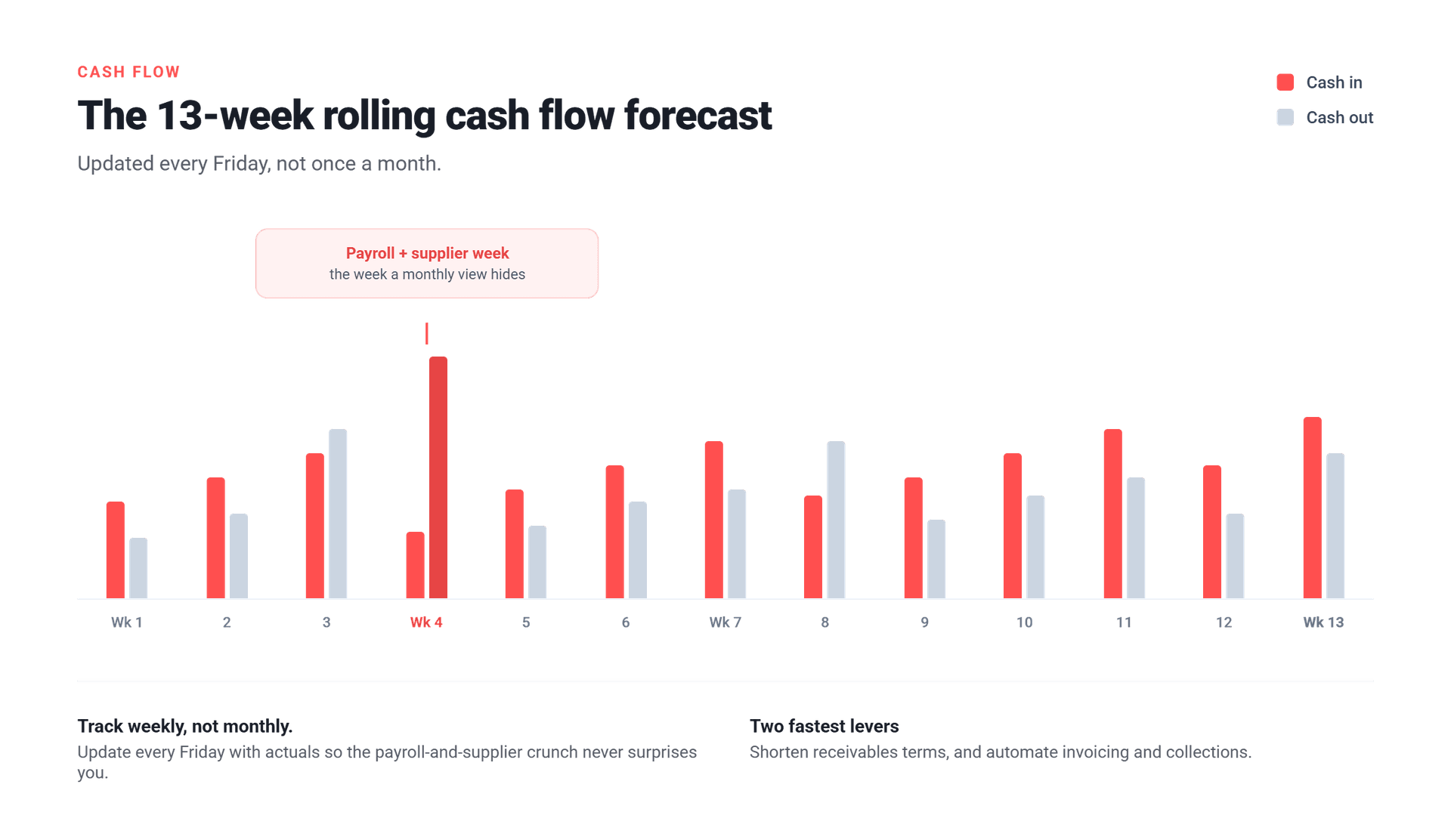
A 13-week rolling cash flow forecast, updated weekly, is the single tool that catches a cash crunch before it becomes an emergency. Most small business owners only look at cash flow after it becomes a problem. By then the options are limited: emergency financing, missed payroll, or asking suppliers for terms they were not expecting to give.
The mechanics are simple even if the discipline is not. Track cash in and cash out by week, not by month, for the next 13 weeks. Update it every Friday with actuals from the week just closed. A monthly view smooths over the week where your biggest supplier payment lands on the same day as payroll, and that is exactly the week that sinks a business with thin reserves.
Two levers move the needle faster than anything else. First, collections: shifting a client from Net 30 to Net 15 terms, or offering a 1-2% discount for payment within 10 days, can shorten your average collection period meaningfully without a single difficult conversation. Second, automation: businesses that automate invoicing and accounts receivable cut their invoice-to-cash cycle by as much as 60% compared to manual chasing. If you are still emailing PDF invoices and tracking payment status in a spreadsheet, that is the first thing to fix, not the last.
Separate Business and Personal Money From Day One
Mixing personal and business finances is the single most common mistake among first-time founders in both the UAE and India, and it is also the easiest to fix. Open a dedicated business bank account before your first invoice goes out, not after your first tax filing forces the question.
In the UAE, most banks require a trade license, Memorandum of Association, and Emirates ID for signatories before they will open a business account, and free zone companies sometimes face extra scrutiny depending on the zone and the bank's own risk appetite. Budget two to four weeks for account opening, longer if your business activity falls into a category banks flag for enhanced due diligence, such as crypto, trading, or certain consultancy models.
In India, current account opening for a registered MSME is usually faster, especially once Udyam registration is in place, but the same logic applies: a business account is what lets you build a credit history that banks and NBFCs can actually assess. Lenders increasingly use GST filing data and current account transaction patterns to underwrite MSME loans, so a business that runs its revenue through a personal account is quietly disqualifying itself from better financing later.
If you run payroll, this separation also matters for compliance. In the UAE, salaries must move through the Wage Protection System (WPS), which means payroll has to come from a proper business account set up for WPS transfers, not an owner's personal card. Our guide on the WPS salary transfer process in the UAE walks through the mechanics if you are setting this up for the first time.
Know Your UAE Corporate Tax and VAT Obligations
The single most time-sensitive item in this entire guide is the UAE's Small Business Relief deadline: December 31, 2026. If your revenue was AED 3 million or less in any of 2024, 2025, or 2026, you can apply for Small Business Relief and pay zero corporate tax for that period, provided you are a UAE resident person, not part of a large multinational group, and not a Qualifying Free Zone Person already claiming the separate 0% free zone regime. Once the scheme expires, that option is gone. A consultancy earning AED 800,000 in profit on AED 2.5 million in revenue currently pays nothing under Small Business Relief; from 2027, the same business could owe roughly AED 38,250 under the standard 9% rate on profit above the AED 375,000 threshold.
Two thresholds get confused constantly, so it is worth separating them clearly. AED 375,000 is a profit threshold, above which the 9% corporate tax rate applies. AED 3,000,000 is a revenue threshold, which determines whether you can even apply for Small Business Relief in the first place. A business can have revenue well under AED 3 million and still owe tax if it never files for relief, and a business can have revenue over AED 3 million and be firmly inside the standard 9% regime regardless of how thin its margins are.
The eligibility test is stricter than a single-year snapshot, too. Revenue has to stay at or under AED 3 million not just in the period being claimed, but in every tax period since the business's corporate tax obligation began. A business that cleared AED 3 million once, even two years ago, cannot claim relief in a later, smaller-revenue year. The election is not automatic either. It has to be made explicitly on EmaraTax when filing the corporate tax return, and claiming it means giving up any tax losses or disallowed interest carried from that period, a trade-off worth running past an accountant if the business has losses on the books.
Separate from Small Business Relief, and worth checking regardless of whether a business qualifies for it, the FTA is currently waiving the AED 10,000 late corporate tax registration penalty under a standing Public Clarification. File the first corporate tax return within seven months of the end of the first tax period (one month ahead of the standard nine-month deadline) and the penalty is waived automatically, no reconsideration request needed. Penalties already paid under the old rules get credited back to the EmaraTax account the same way.
VAT is a separate register entirely. Mandatory VAT registration kicks in once taxable turnover crosses AED 375,000 in the previous 12 months, or is expected to cross it in the next 30 days. Voluntary registration is available from AED 187,500, which matters for early-stage businesses that want to reclaim input VAT on setup costs before mandatory registration would otherwise apply. Registration has to happen within 30 days of crossing the threshold, and missing that window triggers an administrative penalty regardless of how small the delay was.
Know Your India GST and MSME Compliance Obligations
For Indian small businesses, the compliance backbone is Udyam registration paired with GST filing, and the two increasingly work together rather than as separate boxes to tick. Udyam registration is what classifies a business as micro, small, or medium, and that classification is what unlocks access to government-backed credit schemes, priority sector lending, and delayed payment protection under the MSME Development Act.
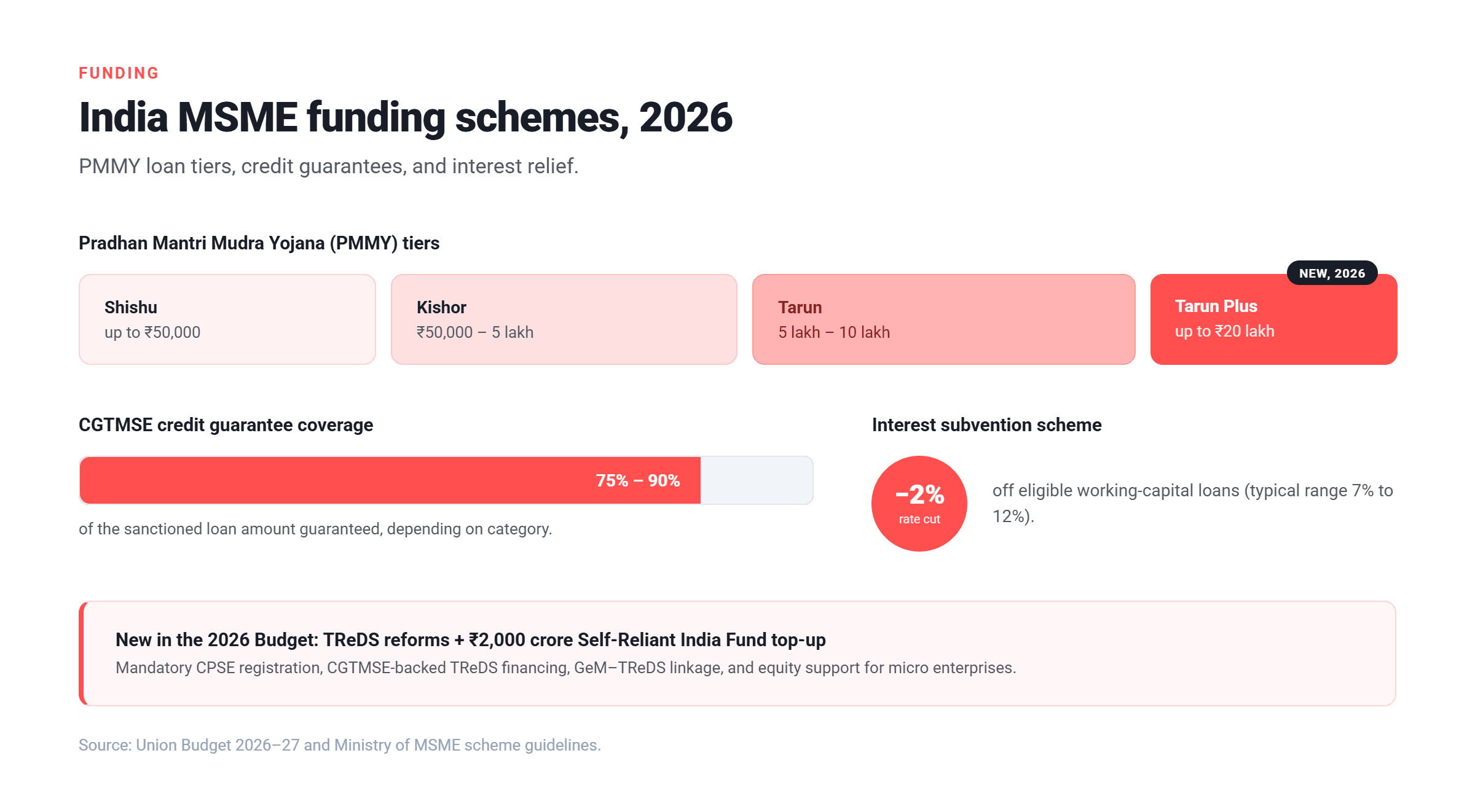
On the funding side, 2026 brought a meaningful shift. The Union Budget announced a dedicated Rs. 10,000 crore growth fund aimed at giving high-potential MSMEs equity-style support to scale rather than just debt. The same Budget also went after MSME liquidity directly through the Trade Receivables Discounting System (TReDS), the platform that lets small suppliers get invoices financed and paid out early instead of waiting on a large buyer's payment cycle.
Four changes stand out: TReDS registration is now mandatory for Central Public Sector Enterprises, a CGTMSE-backed credit guarantee now covers TReDS-based financing, and the Government e-Marketplace (GeM) is being linked directly with TReDS so public-sector purchase orders can be discounted without a separate application. The Self-Reliant India Fund, the equity and risk-capital vehicle running since 2021, also got a Rs. 2,000 crore top-up aimed specifically at micro enterprises that need equity rather than another loan.
Alongside that, the more established schemes remain the backbone of MSME finance: the Credit Guarantee Fund Trust for Micro and Small Enterprises (CGTMSE) covers 75% to 90% of a sanctioned loan amount depending on the category, which is what lets banks lend to businesses that would otherwise struggle to offer collateral. Pradhan Mantri Mudra Yojana (PMMY) loans run in tiers, from Shishu loans up to Rs. 50,000 for very early-stage businesses, through Kishor and Tarun, up to a new Tarun Plus tier introduced in 2026 that allows up to Rs. 20 lakh for borrowers who have already repaid a Tarun loan on time.
GST-based lending deserves specific attention because it changes how you should think about filing discipline. Banks and NBFCs increasingly assess MSME loan applications using GST return history rather than requesting a fresh set of financial statements every time, which means late or inconsistent GST filing does not just risk a penalty from the tax department, it quietly shrinks your borrowing options. An MSME with eighteen months of clean, on-time GST returns is underwriting itself for a faster, cheaper loan without doing anything beyond staying current on a filing it already has to do.
UAE vs India: Quick Reference for 2026
The thresholds and deadlines above are easy to mix up when you are tracking both markets at once, so here is the side-by-side version to bookmark.
Fund Growth Without Overpaying for Credit
Interest rates on MSME loans in India typically range from 7% to 12% depending on the lender, the borrower's credit profile, and whether the loan carries a government guarantee. The Interest Subvention Scheme adds a 2% rate reduction on eligible working capital loans, which sounds small until you run it across a full year on a seven-figure rupee facility. Before accepting a rate from the first lender who says yes, it is worth checking whether the loan qualifies for CGTMSE backing or interest subvention, because the same facility structured through a scheme-eligible lender can carry a meaningfully lower effective cost.
In the UAE, small business lending works differently because there is no direct equivalent of Mudra or CGTMSE. Banks price SME lending on the strength of your trade license history, your bank statement turnover, and increasingly your WPS payroll record as a proxy for business stability. A business with twelve months of consistent banking activity and a clean WPS record is a materially easier underwrite than a brand-new company on paper, even if the underlying business is identical. Corporate cards and revolving credit facilities are often a faster route to working capital than a term loan for UAE SMEs that need short bursts of flexibility rather than a lump sum, particularly for import-heavy businesses managing supplier payment timing.
Get Paid Faster: Invoicing, Collections and E-Invoicing Readiness
Getting paid faster is a finance strategy, not just an operations task, and it costs nothing to implement compared to most financing options. The tactics that move the needle: clear, written payment terms on every invoice, a one-click payment link rather than a request to "transfer to the account below," and a small early-payment incentive for clients who pay inside ten days instead of thirty.
The UAE adds a compliance layer on top of this that businesses need to plan for now rather than later, and the exact deadlines shifted earlier this year. The Ministry of Finance pushed back the Accredited Service Provider (ASP) appointment deadline for large businesses (revenue AED 50 million or more) from July 31, 2026 to October 30, 2026, giving them more time to compare providers and pricing. The mandatory go-live date of January 1, 2027 did not move. Smaller businesses get a longer runway on both ends.
Businesses that wait until their phase becomes mandatory tend to scramble on integration; the ones that adopt payment links and structured PINT-AE invoicing early get the collections benefit now and the compliance readiness for free later. Our detailed breakdown of the UAE e-invoicing and payment links timeline covers exactly which businesses fall into which phase.
India-based businesses selling into the UAE, or UAE businesses invoicing Indian clients, face an added wrinkle: currency and settlement timing. A 30-day payment term quoted in AED can mean a very different effective wait once INR conversion, remittance processing, and correspondent banking delays are stacked on top. Building a small buffer into quoted payment terms for cross-border invoices, and reconciling exchange rate movement monthly rather than only at year-end, prevents small currency swings from quietly eating margin.
Automate the Boring Parts
Manual bookkeeping is where small businesses lose the most time relative to the value it returns, and it is usually the first thing that gets skipped when a founder is busy, which is exactly when it should not be skipped. Cloud accounting software that reconciles bank feeds automatically, categorizes recurring expenses, and flags anomalies catches problems (a duplicate supplier payment, a subscription nobody remembers approving) within days instead of at year-end audit.
Payroll is the other high-value automation target, particularly in the UAE where WPS compliance is mandatory and manual salary processing carries real regulatory risk if a transfer is late or misformatted. A platform that handles WPS-compliant payroll, invoicing, and accounting from one place removes the reconciliation gap between "what the bank shows" and "what the books show," which is where most small business finance errors originate in the first place. This is the exact overlap Peko was built for: company formation, accounting, WPS payroll and HR, corporate cards, and invoicing in one platform for UAE SMEs, so the finance stack does not end up stitched together from four different tools that do not talk to each other.
Build a Buffer for Cross-Border and Currency Risk
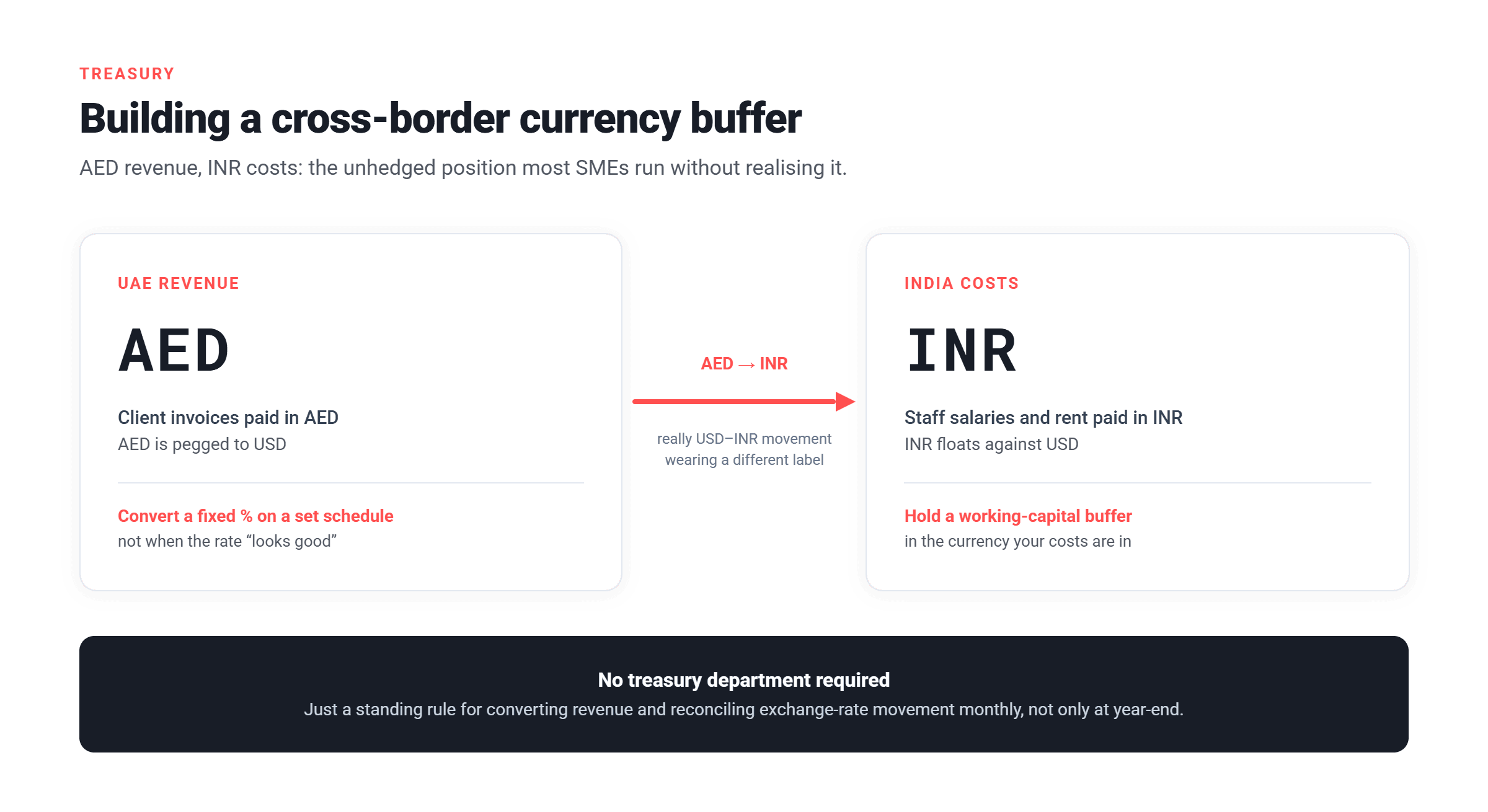
If your business operates in both the UAE and India, whether through a formal cross-border structure or simply by invoicing clients across the corridor, currency movement is a real line item, not a rounding error. AED is pegged to the US dollar, while INR floats, so AED-INR movement is really USD-INR movement wearing a different label. A business that quotes prices in one currency and pays costs in another needs a policy, even an informal one, for how much currency swing it will absorb before repricing.
The practical fix most small businesses skip: hold a portion of working capital in the currency your major costs are denominated in, not just the currency your revenue arrives in. An Indian exporter invoicing UAE clients in AED but paying staff and rent in INR is running an unhedged currency position every single month without necessarily realizing it. It does not require a treasury department to fix, just a standing rule for converting a fixed percentage of incoming AED revenue to INR on a set schedule rather than waiting for a "good" exchange rate that may never arrive. Paying suppliers and payroll across currencies from a single dashboard makes that reconciliation easier to keep on schedule instead of something that only gets checked at month-end.
Which Industries and Business Types This Applies To
These finance tips apply differently depending on what kind of business is reading them, so it is worth being specific rather than pretending one playbook fits every founder.
E-commerce sellers running stores that ship between the UAE and India feel the currency and cross-border invoicing points hardest, since margin gets eaten by exchange rate timing more than by any single fee. Import-export traders and freight forwarders are the group most exposed to the UAE's VAT threshold rules and India's GST-based lending, because their revenue volumes cross the mandatory registration line quickly and their working capital needs are lumpy rather than steady. Independent consultants and freelancers operating under a free zone license or an Indian proprietorship benefit most from the "separate accounts from day one" advice, since this group is the most likely to still be running business income through a personal account. Restaurant, retail, and F&B owners in the UAE are the group with the tightest window on the Small Business Relief deadline, since many sit close to the AED 3 million revenue line and stand to gain the most from applying before the cutoff. Small manufacturing and services MSMEs in India are the direct audience for the CGTMSE and Mudra scheme detail, particularly Tarun Plus borrowers looking to scale past their first working capital facility.
FAQ's
What are the best financial tips for a small business in the UAE in 2026?
The three highest-impact moves for a UAE small business in 2026 are applying for Small Business Relief before the December 31, 2026 deadline if revenue is under AED 3 million, registering for VAT the moment taxable turnover crosses AED 375,000 rather than waiting for the 30-day grace period to run out, and running payroll through a WPS-compliant system to protect both compliance standing and access to future bank financing.
How much revenue triggers corporate tax registration in the UAE?
There is no separate "registration threshold" tied purely to revenue; every taxable person generally needs to register for corporate tax regardless of size, but the tax itself only applies at 9% on profit above AED 375,000. Businesses can apply for Small Business Relief if revenue has stayed at or under AED 3 million in every tax period since their corporate tax obligation began, not just the period being claimed, and the relief must be actively elected on EmaraTax, it is not automatic. Separately, the FTA is currently waiving the AED 10,000 late-registration penalty for businesses that file their first corporate tax return within seven months of their first tax period ending.
What MSME loan schemes are available for small businesses in India in 2026?
The main options are Pradhan Mantri Mudra Yojana (PMMY) loans up to Rs. 20 lakh under the new Tarun Plus tier, CGTMSE-backed loans that carry a government guarantee of 75% to 90% of the sanctioned amount, GST-based working capital loans that use GST filing history for faster underwriting, and the Interest Subvention Scheme, which shaves roughly 2% off the effective interest rate on eligible working capital facilities.
Do I need to register for VAT if I run a small business in the UAE?
Registration becomes mandatory once your taxable turnover exceeds AED 375,000 in the past 12 months, or you expect it to exceed that figure in the next 30 days. Below that, voluntary registration is available from AED 187,500, which can be worth doing early if the business wants to reclaim input VAT on setup costs.
How can a small business improve cash flow without taking on more debt?
Shortening receivables terms, adding a one-click payment link to every invoice, offering a small early-payment discount, and automating accounts receivable collection are the fastest cash flow improvements that do not involve new financing. A 13-week rolling cash flow forecast, updated weekly, is what turns these tactics from occasional habits into a system that actually prevents a shortfall before it happens.
When do UAE businesses need to comply with the e-invoicing mandate in 2026 and 2027?
Large businesses with revenue of AED 50 million or more must appoint an Accredited Service Provider by October 30, 2026 (extended from the original July 31, 2026 deadline) and go live on structured PINT-AE invoicing by January 1, 2027. SMEs under AED 50 million have until March 31, 2027 to appoint a provider and until July 1, 2027 to go live, with government entities following a slightly later timeline through October 1, 2027.
Final Thoughts
None of this is exciting work, and that is exactly the point. The businesses that survive their first few years in the UAE or India are rarely the ones with the cleverest product. They are the ones that filed VAT registration on time, claimed Small Business Relief before the window closed, kept a rolling cash flow forecast instead of finding out about a shortfall from an overdraft notice, and treated GST filing discipline as a financing tool rather than a compliance chore. If you take one thing from this guide, make it the December 31, 2026 Small Business Relief deadline if you are UAE-based and under the AED 3 million revenue line. It is the closest thing either market offers to free money, and it does not stay open indefinitely. The AED 10,000 late-registration penalty waiver is a smaller, quieter version of the same idea, worth checking even if Small Business Relief does not apply to you. Beyond that, pick one habit from this list, the weekly cash flow forecast is the one that pays off fastest, and actually run it for a full quarter before adding a second.
This article is for general information only and is not tax, legal, or financial advice. UAE corporate tax, VAT, and Small Business Relief rules should be verified directly with the Federal Tax Authority, and India GST and MSME scheme eligibility should be confirmed with the Ministry of MSME or a licensed chartered accountant, before making any filing or funding decision.