- Blogs
- Accounting
- Automated Accounting Software in the UAE: What Every Business Needs to Know in 2026
Aug 31, 2026
Automated Accounting Software in the UAE: What Every Business Needs to Know in 2026

Share this article
- Accounting Software UAE 2026: What to Buy for VAT, Corporate Tax and E-Invoicing
- What UAE accounting software actually has to do in 2026
- Why “FTA accredited” does not mean what the badge implies
- Which e-invoicing wave you are actually in
- What changes when you cross AED 3,000,000
- What accounting software costs in the UAE
- The features that matter, and the ones that do not
- Red flags when you are being sold accounting software
- When software alone is not enough
- Which industries and business types this applies to
- Frequently Asked Questions About Accounting Software UAE 2026
- Final Thoughts
Accounting Software UAE 2026: What to Buy for VAT, Corporate Tax and E-Invoicing
Accounting software UAE 2026: the three compliance jobs, VAT at 5%, corporate tax at 0% and 9%, and e-invoicing from 2027
TL;DR:
- If your revenue is under AED 50 million, you are in the second e-invoicing wave: appoint an Accredited Service Provider by 31 March 2027 and start transmitting from 1 July 2027. The 1 January 2027 date everyone quotes is not yours.
- “FTA accredited” and “e-invoicing ready” are two different things, on two different registers. Xero, Wafeq, TallyPrime, Odoo and Naqood sit on the FTA’s tax accounting software register; of those, only TallyPrime is also an accredited e-invoicing provider. Zoho Books is the mirror image: fully accredited to transmit e-invoices, and not on the software register at all.
- Small Business Relief now runs to 31 December 2029, not 2026. If your revenue is near AED 3 million, that changes what your books have to be able to produce.
- Price bands in the UAE run from free, through roughly AED 50 to 350 a month for software, to AED 499 and up when a qualified accountant is doing the work rather than you.
Search “accounting software uae” and the first page of results is mostly vendors explaining why they are the answer, one government register with no explanation attached, and a Reddit thread outranking eleven commercial pages because real people were talking in it. What almost none of those pages will tell you is which compliance deadline actually applies to your business, or that the accreditation badge on a vendor’s homepage may have nothing to do with the e-invoicing obligation landing on you in 2027. This is the version with those answers in it.
Last verified: 31 August 2026. Every rate, threshold, deadline, price and accreditation status below was checked against the Ministry of Finance, Federal Tax Authority or vendor primary source on that date. This page is reviewed quarterly, and after any Ministerial or Cabinet Decision affecting VAT, corporate tax or e-invoicing.
What UAE accounting software actually has to do in 2026
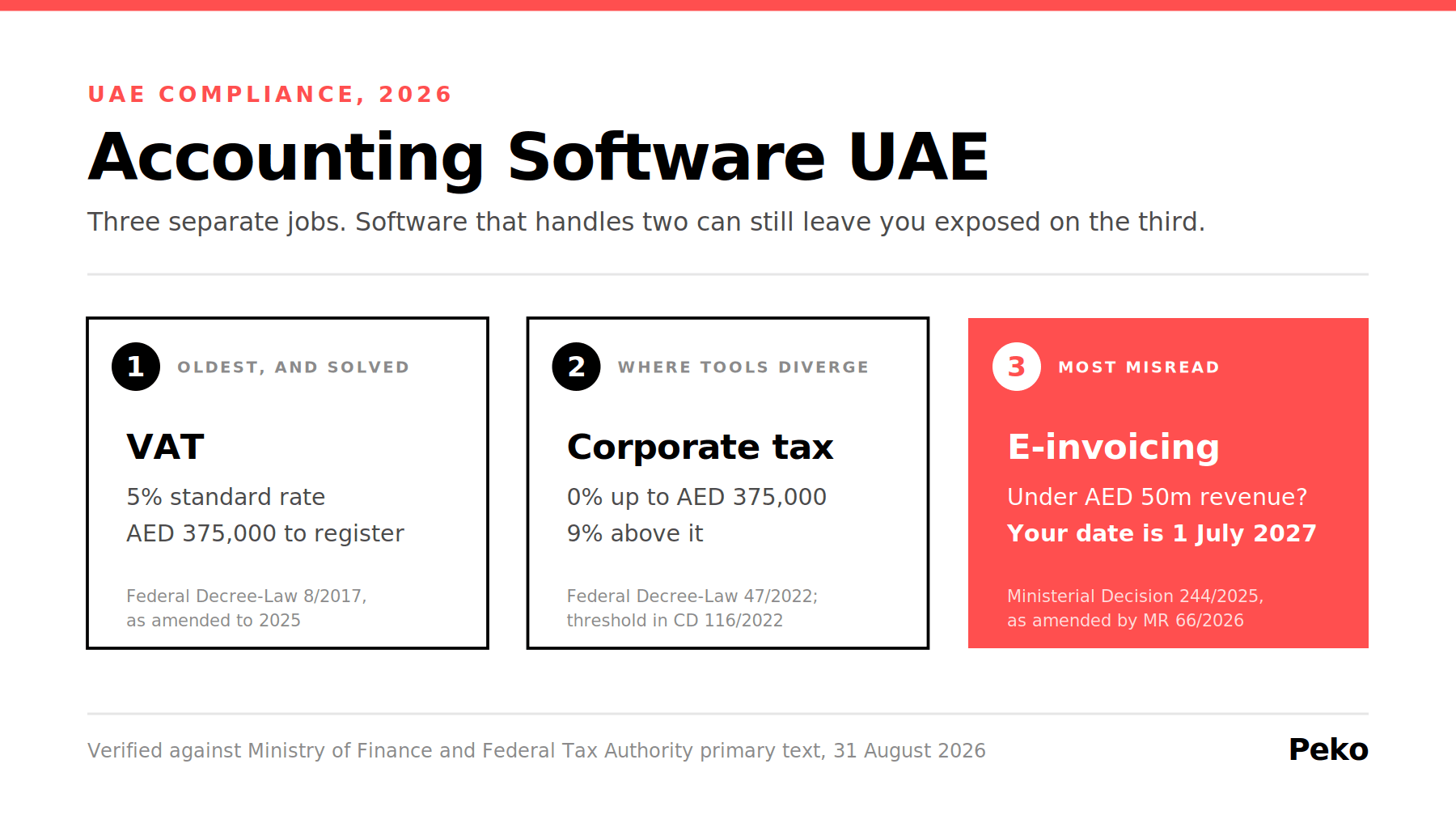
Three separate obligations, not one. Your books have to support a 5% VAT return, a corporate tax return with a 0% band and a 9% band, and from 2027 the machine-to-machine transmission of invoices through an accredited provider. Software that handles the first two well can still leave you completely unprepared for the third.
VAT is the oldest and the best understood. The standard rate is 5%, registration is mandatory once taxable supplies and imports pass AED 375,000, and voluntary from AED 187,500. That sits in Federal Decree-Law No. 8 of 2017, now amended three times over, most recently by Federal Decree-Law No. 16 of 2025 which took effect on 1 January 2026. Any software sold in this market handles VAT; treat it as table stakes rather than a feature.
Corporate tax is where the gap between packages opens up. Under Federal Decree-Law No. 47 of 2022 and its amendments, taxable income up to AED 375,000 is charged at 0% and income above that at 9%. Worth knowing: the AED 375,000 figure is not in the tax law itself. Article 3 defers to a Cabinet decision, and the number lives in Cabinet Decision No. 116 of 2022. The regime applies to financial years starting on or after 1 June 2023, which means most UAE businesses have now filed at least once and know exactly how painful their bookkeeping was.
Late filing is cheaper than most people fear and late registration is more expensive than they expect. Under Cabinet Decision No. 40 of 2017 and its amendments, most recently Cabinet Decision No. 129 of 2025 which took effect on 14 April 2026, a late return costs AED 1,000 for a first offence and AED 2,000 if it happens again within 24 months. Failing to submit a registration application at all costs AED 10,000. Those two numbers get conflated constantly, including on pages that should know better. They are different violations with different price tags.
Why “FTA accredited” does not mean what the badge implies
There are two separate UAE registers, they mean different things, and almost every vendor page conflates them. The FTA’s Tax Accounting Software Register is a voluntary, vendor-side listing about VAT-era record-keeping standards. The Ministry of Finance’s Accredited Service Provider list is the one that governs whether a provider can actually transmit your e-invoices. Being on one tells you nothing about the other.
Here is what that looks like when you check both registers on the same day. This table does not exist anywhere else, because every vendor has a commercial reason not to build it.
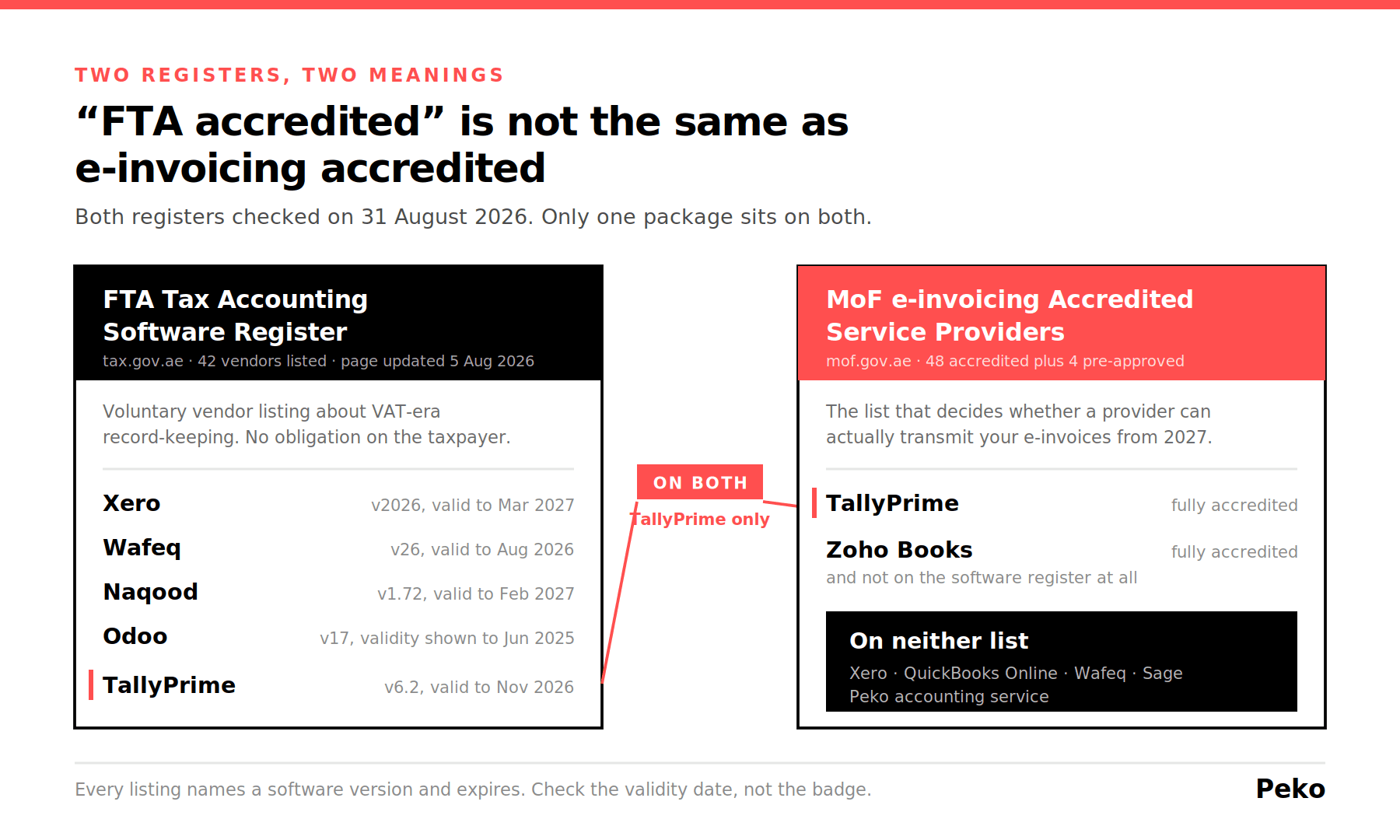
Diagram contrasting the FTA Tax Accounting Software Register with the Ministry of Finance e-invoicing Accredited Service Provider list, showing which accounting packages appear on each
Sources: the FTA register at tax.gov.ae, page updated 5 August 2026, 42 vendors listed; the MoF ASP list, 48 fully accredited providers plus 4 pre-approved, page updated 28 August 2026. Both checked 31 August 2026.
Four things fall out of that table, and each of them is a question to put to a salesperson.
The badge can be technically true and practically useless. A vendor can advertise FTA accreditation, link you to the register to prove it, and still have no route to transmit an e-invoice for you in 2027. Both statements can sit on the same homepage without either being a lie. It runs the other way too: Zoho Books holds no FTA software-register listing at all, and is fully accredited to transmit your e-invoices. Neither register is a proxy for the other, in either direction.
Both lists are snapshots, and they move. Look at the validity column. Wafeq’s listed version, v26, runs only to August 2026, so it is at or past its listed expiry by the time you read this. The Odoo entry shows a validity date more than a year in the past. Listings get renewed and versions get resubmitted, so a lapsed date is not a scandal, but the badge is a state on a date rather than a permanent status. The MoF list moves faster still: in the single week from 24 to 31 August 2026 it went from 44 fully accredited providers to 48, and Zoho moved up from pre-approved to fully accredited. A shortlist built from a comparison post published two months ago is already out of date, including this one. Ask which version is listed and when that listing expires, then check both registers yourself on the day you decide.
We are on neither list, and we will say so. Peko is an accounting service with a dedicated accountant attached, not a listed software vendor and not an Accredited Service Provider. Any platform that implies buying it makes you e-invoicing compliant is selling you something it cannot deliver. The honest version is that your accounting platform’s job is to keep the underlying records clean, correctly coded and exportable for whichever ASP you appoint. That is a real job. It is not the same job.
“Government approved” is not a category that exists. People search for whether QuickBooks is a government-approved accounting system. The FTA’s own wording on the register is permissive and aimed at vendors: providers who declare their software meets the requirements “may be listed” by the Authority. Nowhere does the FTA say a taxable person must use listed software, or that a return filed from unlisted software is defective. If a page tells you otherwise, it is selling, not explaining.
Which e-invoicing wave you are actually in
If your annual revenue is below AED 50 million, your dates are 31 March 2027 to appoint an Accredited Service Provider and 1 July 2027 to start complying. If it is AED 50 million or more, you appoint by 30 October 2026 and comply from 1 January 2027. The single date circulating in most UAE content is the large-business date, and it is the wrong one for the majority of businesses reading about it.
The phasing sits in Ministerial Decision No. 244 of 2025, Article 5, as amended by Ministerial Resolution No. 66 of 2026.
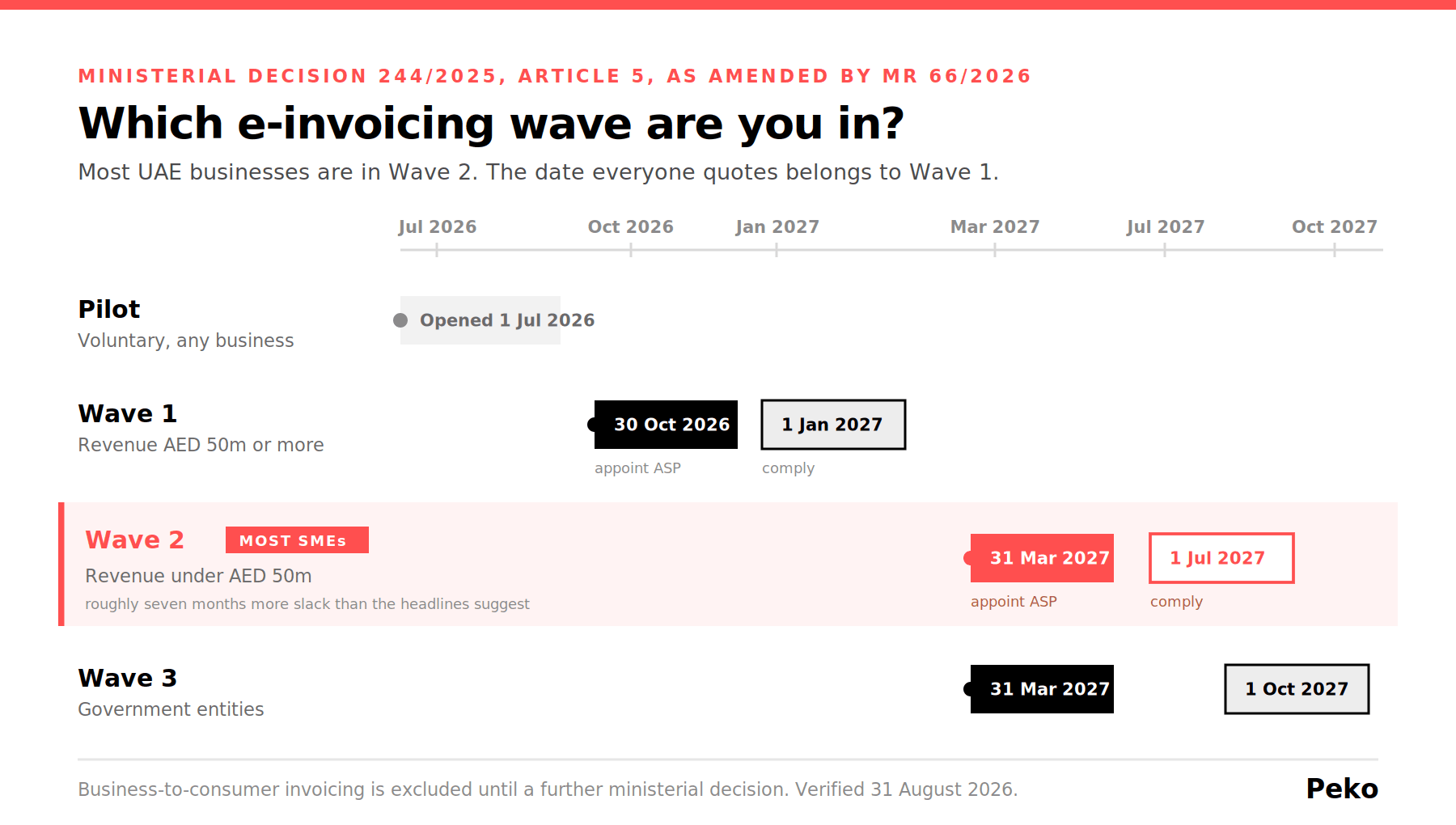
UAE e-invoicing wave timeline showing ASP appointment deadlines and compliance start dates for businesses above and below AED 50 million revenue
Two details that change how you should read that table. The Wave 1 appointment date moved: the original decision said 31 July 2026, and Ministerial Resolution No. 66 of 2026 pushed it to 30 October 2026 while leaving the 1 January 2027 go-live untouched. Some official guidance documents still print the superseded date, so check the amendment rather than the handbook. And business-to-consumer invoicing is excluded until a further ministerial decision, which means a business selling exclusively to consumers is currently out of scope altogether.
The scope rules are in Ministerial Decision No. 243 of 2025, and provider accreditation runs under Ministerial Decision No. 64 of 2025, itself amended by Ministerial Resolution No. 56 of 2026. The model is a five-corner arrangement: you send to your provider, your provider sends to the buyer’s provider, the buyer receives, and both providers report a tax data document to the FTA. The UAE format is PINT AE, built on the OpenPeppol standard.
Penalties are set out separately in Cabinet Decision No. 106 of 2025, and the interesting ones are the ones nobody writes about.
Two things in that table deserve more attention than they get. The first is that every row is drafted around a deadline: each violation reads “within the timeline prescribed by the Minister”. The per-invoice penalty therefore punishes lateness rather than error. A business that transmits accurate invoices three days late every week is exposed; a business that transmits a wrong invoice on time and corrects it is not caught by this particular rule. That distinction should shape which part of your process you automate first.
The second is that the schedule has six rows, not five, and two of them fall on the recipient of an invoice rather than the sender. If a system failure stops you receiving invoices and you do not notify the Authority in time, that is your AED 1,000 a day, not your supplier’s. Most UAE summaries of this decision list five penalties and quietly drop the recipient-side one, which leaves buyers assuming e-invoicing compliance is entirely a sender problem. It is not.
For a Wave 2 business, the practical read is that you have roughly seven months more slack than the headlines suggest, and the cheapest time to change accounting systems is before you appoint a provider, not after. Migrating a chart of accounts is annoying. Migrating one that is already wired into a live transmission pipeline is a project.
What changes when you cross AED 3,000,000
Small Business Relief lets a resident business with revenue at or below AED 3,000,000 elect to be treated as having no taxable income, and it now runs to tax periods ending on or before 31 December 2029. That extension was made on 29 July 2026, and a large amount of UAE content still says the relief expires at the end of 2026.
The instrument is Ministerial Decision No. 131 of 2026, issued on 29 July 2026, which replaced Article 2(2) of Ministerial Decision No. 73 of 2023 and moved the cutoff from 31 December 2026 to 31 December 2029. The AED 3,000,000 threshold itself is unchanged, and it is a cumulative test: you have to have been at or below it in the relevant tax period and in every previous one. Correct citation from now on is Ministerial Decision No. 73 of 2023 as amended by Ministerial Decision No. 131 of 2026.
Nobody writing about accounting software has connected this to software selection, which is odd, because the AED 3 million line is exactly where your requirements change shape.
Below it, with the election made, you need clean revenue records and enough discipline to prove you are under the threshold. A lightweight invoicing tool can genuinely be sufficient. Above it, you are filing a real corporate tax return, which means accrual-basis accounting, financial statements consistent with accepted standards, depreciation schedules, provisions and accruals, and a defensible audit trail behind every number. That is a different class of product, and it is not something you retrofit in the last quarter before a filing deadline.
The planning implication is uncomfortable and worth saying plainly: if you expect to cross AED 3 million within two years, buying for where you are today usually costs more than buying for where you are going. The extension to 2029 does not remove that decision, it just gives you more time to make it well.
On record keeping, the Tax Procedures Executive Regulations require a taxable person to keep records for five years after the relevant tax period, with real-estate records kept for seven. Corporate tax records are held to a longer standard under the corporate tax law itself, and an amendment effective 1 April 2026 added two further years where a refund claim is still pending. Whichever bracket applies to you, the software question is the same: can you export a complete, readable set of records if the FTA asks, after you have stopped paying the subscription?
What accounting software costs in the UAE
Real UAE pricing falls into three bands, and the honest way to compare them is by who does the work rather than by feature count. Putting a AED 49 self-serve tool in the same table as a service with a qualified accountant attached produces a comparison that flatters one and misrepresents both.
Three things that table makes visible. Software pricing in this market is genuinely cheap, so cost is rarely the real constraint. The jump from the second band to the third is roughly fivefold, and what you are buying with it is somebody else’s time and judgment, not more features. And free tiers in the UAE tend to be capped by revenue rather than by feature, which means they expire on you at exactly the point your accounting gets harder.
One caution on price research generally: two of the largest pages ranking for accounting software in the UAE quote US dollars to a UAE buyer, and two more quote no numbers at all. Check the vendor’s own regional pricing page and check the billing basis, because a monthly headline price quoted on annual billing is common and the difference is real money.
For the full head-to-head on features across the major packages, including the AI-native entrants and traditional firms, see our comparison of the best accounting software in the UAE. This page is about what to automate and which rules apply; that one is about which product wins on which criterion.
The features that matter, and the ones that do not
Judge accounting software on five things in this market: whether it produces a corporate tax return you would defend, whether its records survive an FTA request, whether it can hand clean data to an ASP, whether it handles Arabic where you need it, and whether a human can reach support when a filing deadline is 48 hours away.
Things worth paying for:
- Corporate tax reporting, not just VAT. VAT support is universal; corporate tax support ranges from real to decorative. Ask to see a sample corporate tax working, not a marketing claim.
- A genuine audit trail. Every edit attributable to a user, with a timestamp, and no way to silently overwrite history. This is the feature you will care about only once, and you will care enormously.
- Named UAE bank connectivity. “Bank integration” is not an answer. Ask which UAE banks connect directly, which connect through an intermediary, and which require manual statement uploads. Get the answer for your bank, by name, in writing, and confirm it against your own account during the trial. Coverage changes, and it is uneven across the largest UAE banks.
- Arabic invoicing where you actually need it. Some packages produce bilingual invoices, at least one is explicitly English-only. If you invoice government entities or larger local corporates, settle this before you buy, and ask specifically about right-to-left rendering in exported PDFs rather than just Arabic field labels.
- A clean export. You should be able to leave with your data in a readable format. If you cannot picture how you would migrate off it, you are not buying software, you are buying a hostage situation.
Things sold hard that rarely decide the outcome: the number of dashboards, integrations with tools you do not use, “AI-powered” as an unqualified claim, and app-store ratings from other countries. On AI specifically, the useful question is narrow: what does it do without asking me, and what does it flag for me to approve? Categorisation suggestions and duplicate detection genuinely save hours. A chat window over your ledger mostly does not.
Red flags when you are being sold accounting software
Five things that should slow a purchase down. A badge with no register link or no validity date. A claim of e-invoicing readiness with no mention of ASP status or of which wave you are in. Pricing quoted in a currency you do not bank in. Support that exists only as email or a ticket queue, which is the wrong answer when a VAT deadline is tomorrow. And a demo that shows you invoicing but never shows you a filing.
One more, softer signal: if the salesperson cannot tell you plainly what their product does not do, you are talking to marketing rather than to someone who understands the compliance side. The vendors worth trusting in this market are noticeably comfortable naming their own gaps.
When software alone is not enough
Automation removes the mechanical work and none of the judgment. Software will code a transaction the way you taught it to; it will not tell you the classification was wrong, that a related-party transaction needs documenting, or that an election you made two years ago is about to stop applying.
That is the case for the hybrid arrangement, and it is honestly not always the right answer. If you run a single-entity service business, invoice a handful of clients a month, and sit comfortably under the Small Business Relief threshold, good software plus an hour of your own attention each week is genuinely enough. Paying AED 499 a month for an accountant to reconcile 20 transactions is not a smart allocation of money.
The calculation flips when any of these is true: you are near or over AED 3 million in revenue, you hold inventory, you operate more than one entity or a free zone and mainland pair, you have related-party transactions, or your last VAT or corporate tax filing involved a scramble. At that point the constraint is not data entry, it is interpretation, and interpretation is what you are short of.
If you would rather not make that call alone, Peko’s accounting service puts a dedicated accountant on your books alongside the software, from AED 499 a month. Note the limits honestly: we are not a listed FTA software vendor, we are not an Accredited Service Provider, and compliance obligations remain yours. What we do is keep the records clean enough that whatever you file, and whichever provider you eventually appoint, has good data underneath it.
Getting the corporate tax side registered correctly is a separate and prior question; our guide to corporate tax registration in the UAE covers the process and the deadlines. If e-invoicing is the part keeping you up, the UAE e-invoicing and payment links guide goes deeper on the transmission model and what an ASP appointment actually involves. And if you are choosing tools for the first time, our notes on choosing accounting tools for a small business is the shorter, more practical starting point.
Which industries and business types this applies to
The compliance picture above lands hardest on specific business shapes rather than on “UAE SMEs” generally.
Trading and import or export companies, typically in JAFZA, DMCC or a mainland Dubai licence. High invoice volume, inventory, multi-currency, and usually the first businesses to feel the per-invoice e-invoicing penalty structure. These need real accrual accounting well before they cross AED 3 million.
Professional services firms, consultancies, agencies, law and design practices. Low transaction volume, high value per invoice, and often the clearest case for staying on lightweight software plus periodic review rather than a full service.
Retail and food and beverage, where a point-of-sale system is the real system of record and the accounting package’s job is to reconcile against it. The question here is integration, not features.
Contracting and construction, where retention, progress billing and long project cycles break most simple invoicing tools. Corporate tax makes work-in-progress treatment matter in a way VAT alone never did.
Free zone entities and holding structures, which have distinct corporate tax positions and often more than one set of books. These are the businesses least well served by generic software-selection content, and the ones most likely to need advice alongside a subscription.
Businesses selling only to consumers, who are currently outside the e-invoicing scope entirely and should not be sold an urgent ASP story. The rules can change, and the exclusion runs only until a further ministerial decision, but today it applies.
Frequently Asked Questions About Accounting Software UAE 2026
Which accounting software is FTA approved in the UAE?
The FTA maintains a Tax Accounting Software Register, which held 42 vendors when checked on 31 August 2026. Xero, Wafeq, TallyPrime, Odoo and Naqood appear on it; Zoho Books, QuickBooks and Sage do not. Each entry names a specific software version and a validity date, so check both rather than trusting a badge. Being on this register is a voluntary vendor listing about record-keeping standards. The FTA does not require taxable persons to use listed software, and this register is a separate thing from e-invoicing accreditation: Zoho Books is absent from it while being fully accredited to transmit e-invoices.
Is e-invoicing mandatory in the UAE, and when does it apply to my business?
It becomes mandatory in waves under Ministerial Decision No. 244 of 2025. Businesses with revenue of AED 50 million or more must appoint an Accredited Service Provider by 30 October 2026 and comply from 1 January 2027. Businesses under AED 50 million must appoint by 31 March 2027 and comply from 1 July 2027. Government entities comply from 1 October 2027. Business-to-consumer invoicing is excluded until a further ministerial decision.
How much does accounting software cost in the UAE?
Local packages start free and run to roughly AED 50 to 100 a month on annual billing. Mid-market cloud software checked on 31 August 2026 ranges from AED 69 to AED 799 a month depending on tier and user count, exclusive of local taxes. An accounting service with a dedicated accountant attached starts around AED 499 a month. Free tiers in this market are usually capped by annual revenue rather than by feature.
Can accounting software handle both VAT and corporate tax in the UAE?
VAT support is close to universal in software sold into this market. Corporate tax support varies widely, from genuine tax computations and adjustment schedules down to a report you still have to rework by hand. Ask to see a sample corporate tax working during the demo. The difference matters most once you are over the AED 3,000,000 Small Business Relief threshold and filing a full return.
Is free accounting software good enough for a UAE small business?
It can be, for a while. A free tier is usually workable if you are under the Small Business Relief threshold, invoice a modest number of clients, hold no inventory and operate a single entity. Watch the revenue cap rather than the feature list, because free plans in the UAE tend to expire at a revenue figure, and that figure often sits well below the point where your accounting becomes complicated.
What happens if I file my UAE VAT return late?
A late return carries an administrative penalty of AED 1,000 for a first offence, rising to AED 2,000 if it happens again within 24 months, under Cabinet Decision No. 40 of 2017 as amended. This is often confused with the AED 10,000 penalty, which applies to failing to submit a registration application rather than to filing late. Late payment carries separate charges, so a filed return with an unpaid balance is not a resolved position.
Final Thoughts
The interesting decision in UAE accounting software is not which product has the longest feature list. It is whether you have understood which rules apply to you, because that is what determines whether a AED 69 subscription is a smart purchase or a false economy.
If you take one thing from this page, make it the two-register distinction. The gap between “FTA accredited” and “accredited e-invoicing provider” is where UAE businesses are going to get caught in 2027, and it exists because it suits almost everyone selling into this market to leave it blurry. Check both lists yourself. They are public, they are free, and they take four minutes.
Then work out your own wave and your own threshold position, and buy for the business you will be in eighteen months rather than the one filing this quarter. If that turns out to need a person as well as a subscription, talk to our accounting team and ask us the same hard questions we have suggested asking everyone else.
This article is general information, not tax or legal advice. Rates, thresholds and deadlines change. Verify your own position against the Federal Tax Authority and Ministry of Finance, or with a qualified UAE tax adviser, before acting.